
That sharp, stinging smell often associated with public swimming areas isn’t a sign of a clean pool. It’s actually a signal that your water is chemically overwhelmed by “dead” chlorine. When homeowners ask what does shock do to a pool, they’re usually looking for a way to fix cloudy water or stop eye irritation before the next weekend gathering. In the high-heat environment of Arizona, where the sun and dust constantly challenge your water chemistry, shocking acts as a vital reset button for your backyard sanctuary.
It’s frustrating to invest in a beautiful outdoor space only to have it feel uninviting due to dull water or lingering odors. You deserve the peace of mind that comes with a perfectly balanced environment for your family. This guide explains how shocking destroys contaminants that standard filtration can’t reach, ensuring your water remains crystal clear and safe. We’ll walk through the science of oxidation, debunk common myths about chemical usage, and provide a clear path to lower long-term maintenance costs through better chemical precision.
Key Takeaways
- Understand exactly what does shock do to a pool by learning how it oxidizes organic contaminants and resets your water’s sanitizing power.
- Learn why a strong “chlorine smell” actually signals a need for more treatment rather than an over-chlorinated pool.
- Differentiate between Free Chlorine and Combined Chlorine to maintain a healthy environment that’s gentle on skin and eyes.
- Master a maintenance schedule tailored for the Tucson climate, ensuring your water recovers quickly after dust storms or heavy use.
- Protect your pool’s infrastructure, including high-performance Pentair pumps, by preventing the scale buildup caused by improper chemical balance.
What Does Pool Shock Actually Do? The Mechanism Explained
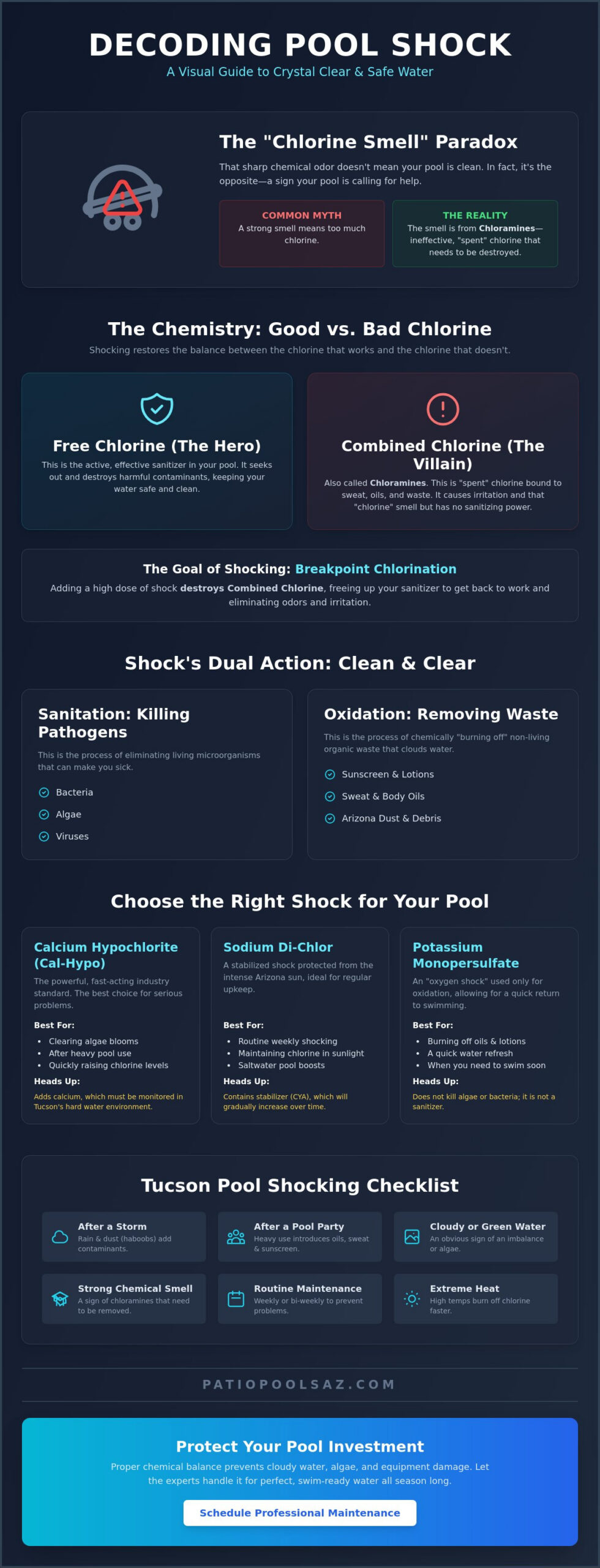
To understand what does shock do to a pool, think of it as a heavy duty chemical reset. While standard pool chemicals like chlorine tablets work steadily to maintain a safe baseline, shocking involves adding a concentrated dose of chemicals to significantly raise Free Chlorine levels for a short period. This process, technically known as Shock chlorination, is essential for breaking down the chemical bonds that make your water cloudy, dull, or irritating to the skin.
The primary goal of shocking is to reach a state called Breakpoint Chlorination. This is the precise moment when the concentration of chlorine is high enough to “break” the molecular bonds of combined chlorine, also known as chloramines. Chloramines are the “spent” chlorine particles that cause that classic chemical smell and stinging eyes. By adding a massive dose of fresh sanitizer, you effectively burn off these spent particles, leaving behind only the active, effective Free Chlorine that keeps your swimming environment healthy. It is a necessary step that goes far beyond what daily tablets can achieve on their own.
Oxidation vs. Sanitation: Why You Need Both
Sanitation is the act of killing living pathogens like bacteria, viruses, and algae. Oxidation is different; it’s a chemical process that “burns off” non-living organic waste. In our unique Arizona climate, your pool faces a constant barrage of contaminants that require both actions. Desert dust from seasonal haboobs, heavy sunscreen from summer afternoons, and even sweat all contribute to a heavy organic load. While sanitation keeps the water safe from germs, oxidation keeps it clear by removing the physical debris that creates a murky appearance. Without regular oxidation, your water eventually becomes “thick” with organic matter, making it harder for your pump and filter to do their jobs.
The Three Main Types of Pool Shock
Choosing the right shock depends on your specific needs and the current state of your water chemistry. Most homeowners rely on these three primary options:
- Calcium Hypochlorite (Cal-Hypo): This is the industry standard for a reason. It is powerful and fast acting, making it the best choice for clearing up algae blooms or handling heavy bather loads. It does add a small amount of calcium to the water, which is a factor to monitor in Tucson’s hard water environment.
- Sodium Di-Chlor: This is a stabilized form of shock, meaning it contains Cyanuric Acid to protect the chlorine from being burned off by the intense Arizona sun. It’s excellent for routine maintenance, though it will gradually raise your stabilizer levels over time.
- Potassium Monopersulfate (Non-Chlorine): This is an “oxygen shock” used purely for oxidation. It doesn’t kill algae, but it’s perfect for burning off oils and lotions. Because it isn’t a sanitizer, you can typically swim just 15 minutes after application.
5 Common Myths About Pool Shocking Debunked
Understanding the truth behind common misconceptions is the first step toward maintaining a pristine backyard environment. Many homeowners rely on outdated advice that can lead to murky water or unnecessary chemical costs. By debunking these myths, we can better understand what does shock do to a pool and how to use it effectively as a preventative tool rather than just a last resort.
The “Chlorine Smell” Paradox
It’s a common belief that a strong chemical odor means there is too much chlorine in the water. In reality, that pungent scent is caused by the formation of chloramines, which occur when active chlorine binds with organic waste like sweat, oils, or nitrogen. These “spent” particles are no longer effective at cleaning. If your pool smells like a locker room, it actually needs MORE chlorine to break down the smelly waste. Shocking the water provides the surge of fresh sanitizer needed to reach breakpoint chlorination and eliminate those odors for good.
Another prevalent myth is that you only need to shock when the water turns green. While shocking is the primary cure for an algae bloom, it should also be used as a proactive measure. Heavy Arizona monsoon storms or a weekend of family gatherings can introduce a massive amount of organic debris. Waiting for the water to cloud over means the bacteria have already taken hold. Routine treatment keeps the water clear before problems become visible.
Shocking Saltwater Systems
Saltwater pool owners often assume their systems are self-sufficient. While a salt cell generates chlorine, it can easily be overwhelmed by high temperatures or heavy use. Most systems have a “Boost” or “Super-Chlorinate” setting, but this puts significant strain on the cell and may not be enough for a true chemical reset. Manual shocking is often faster and more effective for clearing contaminants. Maintaining proper pool alkalinity is also critical in these systems to ensure the chlorine remains effective and the pH stays stable.
Safety and longevity are also at the heart of proper shocking. You cannot swim immediately after adding liquid or granular shock. You must wait until the free chlorine levels return to a safe range, typically below 5.0 ppm. Additionally, don’t fear for your pool finish; properly applied shock won’t damage your liner or tile. The risk only arises if you allow undissolved granules to sit on the floor of the pool, which can lead to bleaching or scaling. Always brush the pool floor after application to protect your investment. If you’re unsure about your chemical balance, our experts can provide professional water testing and chemicals to keep your sanctuary in peak condition.
The Chemistry: Free Chlorine vs. Combined Chlorine
To truly master your water chemistry, you must look beyond the basic readings on a standard test strip. Total Chlorine (TC) is a common metric, but it only tells half the story because it is the sum of two very different components: Free Chlorine and Combined Chlorine. Free Chlorine (FC) is the active sanitizer that is ready to destroy bacteria and algae. Combined Chlorine (CC), on the other hand, consists of “spent” chloramines that have already bonded with organic waste. When these two are added together, they give you the Total Chlorine reading.
When we ask what does shock do to a pool, we are looking for a way to reset this balance. If your Total Chlorine is high but your Free Chlorine is low, it means your water is saturated with ineffective chloramines. This state creates the irritation and odor that often drives swimmers out of the water. Understanding how pool chemicals work at a molecular level allows you to see that simply adding a small dose of chlorine isn’t enough. You need a massive surge to clear the waste and free up the sanitizer to do its job.
The Goal: Reaching Breakpoint Chlorination
To effectively clear the water, you must reach a state called breakpoint chlorination. This requires a specific ratio known as the 10:1 rule. Your Free Chlorine level must be raised to at least ten times the amount of your Combined Chlorine. For example, if your test shows 0.5 ppm of Combined Chlorine, you need to bring your Free Chlorine up to at least 5.0 ppm. If you “under-shock” by adding only half the required amount, you don’t actually destroy the chloramines. Instead, you unintentionally create even more of them, making the water cloudier and more irritating than it was before the treatment.
How UV Rays Affect Your Chlorine Levels
The intense Southern Arizona sun is a relentless “chlorine killer.” Without protection, the UV rays from a clear Tucson sky can destroy up to 90% of your pool’s chlorine in just two hours. This is why we rely on Cyanuric Acid, often called stabilizer or “pool sunscreen,” to protect the chlorine from being burned off. Even with a stabilizer in place, the best strategy for a chemical reset is to shock at night. By applying the treatment after the sun goes down, the chlorine has several hours to work at maximum strength without being degraded by UV light. This methodical approach ensures you get the full value of your pool chemicals and provides a deeper, more effective clean for your backyard sanctuary.
Practical Guide: When and How to Shock a Tucson Pool
Maintaining a pool in Southern Arizona requires a proactive approach that respects the local environment. While a weekly maintenance schedule is a great baseline, our climate often demands more frequent attention. Understanding what does shock do to a pool is only half the battle; knowing when to apply it in the desert is what saves your water from turning into a swamp overnight. Consistent testing and a steady hand ensure your backyard sanctuary remains a source of pride rather than a chore.
Tucson-Specific Shocking Triggers
Seasonal weather patterns in Tucson create unique challenges for pool owners. During the monsoon season, a single haboob can dump several pounds of fine desert dust and organic debris into your water. This sudden influx of contaminants can deplete your chlorine levels instantly. Similarly, sustained 110-degree days accelerate chemical evaporation and encourage rapid algae growth. If you’ve hosted a large weekend pool party, the increased bather load introduces oils and sweat that standard filtration cannot handle alone. By learning what does shock do to a pool during these peak stress times, you can prevent a total chemical collapse before it starts.
The Pre-Shock Checklist
Before you add a single ounce of shock, you must ensure your water is ready to receive it. The most critical step is adjusting your pH to between 7.2 and 7.4. If your pH is too high, the chlorine becomes sluggish and significantly less effective. You should also take a moment to clean out the skimmer and pump baskets. Proper circulation is essential for distributing the chemicals evenly and preventing concentrated pockets of chlorine from sitting on your pool floor. For those who need fresh supplies, visiting a pool supply store near me ensures you are using high-potency chemicals that haven’t lost their strength on a hot shelf.
When you are ready to begin, always prioritize safety. Wear protective gloves and goggles to shield yourself from concentrated oxidizers. If you are using granular shock, it’s best to pre-dissolve it in a bucket of pool water before pouring it around the perimeter. This prevents granules from settling on the tile or plaster. After application, wait at least 24 hours or until your free chlorine levels drop below 5.0 ppm before allowing pets or children back into the water. If you find the chemical balancing process overwhelming, our team offers comprehensive Weekly Pool Maintenance Plans to handle the heavy lifting for you.
Professional Maintenance: Protecting Your Pool Investment
Your swimming pool is more than just a place to cool off; it’s a significant investment in your home’s value and your family’s quality of life. While understanding what does shock do to a pool helps you manage the water day-to-day, professional oversight ensures that the delicate chemical balance doesn’t inadvertently damage your expensive equipment. Improperly managed water is one of the leading causes of premature system failure, often resulting in hardware repairs that could have been avoided with consistent, expert care.
When chloramines and imbalanced pH are left unchecked, they do more than just irritate swimmers. High levels of combined chlorine can become corrosive, slowly eating away at the delicate seals and heat exchangers within your heater. This chemical aggression also impacts the longevity of high-performance hardware like Pentair pool pumps. These variable-speed pumps are designed for maximum efficiency, but they rely on balanced water to maintain their internal components. By keeping your chemistry within the proper ranges, you prevent the scale buildup that forces your motor to work harder, ultimately extending the life of your entire filtration system and preventing the need for early pool resurfacing.
Equipment Protection and Longevity
The relationship between water chemistry and equipment health is often overlooked by the average homeowner. Beyond the pump and heater, the very surface of your pool is at risk when chemicals are mismanaged. Professional water testing at a Patio Pools retail location provides a level of precision that standard home test strips simply cannot match. We analyze the saturation index to ensure your water is neither corrosive nor scale-forming, protecting your plaster and tile from the permanent damage caused by aggressive chemical swings.
Why Homeowners Choose Weekly Service
Many Tucson homeowners find that the technical requirements of desert pool chemistry are a heavy burden during the hottest months of the year. Our local water is naturally mineral-heavy, which complicates the way chemicals react during the shocking process. This is why our Weekly Pool Maintenance Plans are so valued in the community. Our technicians understand the nuances of Southern Arizona’s water profile, providing the precise adjustments needed to prevent “green pool” outbreaks before they start.
Since 1969, Patio Pools & Spas has served as a steady, guiding hand for the Tucson community. We believe that a pool should be a sanctuary of peace, not a source of stress. Choosing professional care means you don’t have to spend your weekends testing vials or worrying about what does shock do to a pool when the monsoons hit. We take pride in our craftsmanship and our commitment to your pool’s longevity, ensuring your backyard remains a beautiful, healthy environment for years to come.
Master Your Backyard Sanctuary with Expert Care
Mastering your pool’s chemistry is the essential key to maintaining a true backyard sanctuary. We’ve explored how reaching breakpoint chlorination clears away irritating chloramines and how the intense Arizona sun dictates a strategic nighttime shocking schedule. Understanding what does shock do to a pool allows you to protect both your family’s comfort and your pool’s long-term infrastructure. This includes safeguarding the plaster finish and ensuring the durability of your high-efficiency Pentair equipment.
Since 1969, Patio Pools & Spas has remained a trusted fixture in the community. Our locally owned and operated team serves as expert Pentair equipment repair specialists; we also offer free professional water testing at all our retail locations to keep your water chemistry precise. We invite you to experience the peace of mind that comes with a perfectly balanced and professionally managed environment. Schedule your professional weekly pool cleaning in Tucson today! Let us handle the complex science of the desert climate so you can return to the quiet satisfaction of a crystal clear swim.
Frequently Asked Questions
How long should I wait to swim after shocking my pool?
You should typically wait at least 24 hours or until your free chlorine levels drop below 5.0 parts per million (ppm). Swimming too soon can lead to skin irritation or bleached swimwear. It’s best to test the water before allowing anyone back in. For non-chlorine shocks, the wait time is much shorter, often just 15 minutes, as these products oxidize waste without significantly spiking the sanitizer levels.
Can I shock my pool during the day in Arizona?
You can shock during the day, but it is much less effective due to the intense Southern Arizona sun. UV rays can destroy up to 90% of unstabilized chlorine in just two hours. To get the full benefit of what does shock do to a pool, apply the treatment after sunset. This allows the chemicals to work through the night without being degraded by sunlight, ensuring a deeper and more efficient chemical reset.
Why is my pool still cloudy after I shocked it?
Cloudy water after shocking often indicates that the treatment has successfully killed algae or bacteria, leaving behind microscopic debris. Your filtration system needs time to remove these particles. It could also mean you didn’t add enough shock to reach breakpoint chlorination, leaving partially oxidized waste in the water. Ensure your pump is running and your filter is clean to help clear the remaining cloudiness over the next 24 to 48 hours.
Is liquid shock better than granular shock for Tucson pools?
Neither is objectively better; the choice depends on your specific needs. Liquid shock is fast-acting and doesn’t add calcium, which is helpful in Tucson’s hard water. However, granular shock like calcium hypochlorite is more concentrated and easier to store. If you use granular products, always pre-dissolve them in a bucket first to prevent the particles from settling on and damaging your pool’s interior surface or tile.
What happens if I put too much shock in my pool?
Adding too much shock will result in excessively high chlorine levels that take much longer to return to a safe range. This can lead to the bleaching of pool surfaces or irritation for swimmers. In extreme cases, very high chlorine can even damage your pool equipment seals or heat exchangers. If you over-shock, you simply have to wait for the sun to naturally degrade the chlorine or use a chemical neutralizer to lower the levels.
Do I need to run my pool filter while shocking?
Yes, running your filter is essential because circulation ensures the shock is distributed evenly throughout the entire body of water. The filter also works to remove the organic contaminants that the shock is busy oxidizing. We recommend running your pump for at least 8 to 12 hours after a treatment. This consistent movement prevents concentrated chemical pockets and helps your Pentair pump system maintain the clarity and health of your backyard sanctuary.
Will shocking my pool get rid of algae completely?
Shocking is highly effective at killing active algae blooms, but it isn’t always a complete solution on its own. You must also brush the pool walls and floor to break up algae colonies and allow the chlorine to reach them. Once the algae is dead, your filtration system must run continuously to remove the debris. For severe infestations, a double or triple dose of shock may be required to fully understand what does shock do to a pool when fighting stubborn growth.
Can I shock a pool without a pump running?
You should never shock your pool without the pump running. Without active circulation, the concentrated chemicals will settle at the bottom of the pool, which can cause permanent bleaching or damage to your plaster and tile. Proper water movement is required to spread the sanitizer and ensure it reaches every corner of the pool. Always verify that your pump is functioning correctly before adding any high-dose chemical treatments to your water.